It was a freezing cold morning when Henry and I left Ventosa. But we were in fine spirits as it was his birthday. The walk began with an ascent of the summit of Alto Poyo de Roldan a climb of 110 metres, not that bad, but not what you want to do first thing in the morning. This hill is the supposed site where Roldan (Roland) the greatest of Charlemagne's knights killed the Muslim giant Farragut with a well aimed rock, freeing Christian knights who were being held captive by the giant. The tale is reminiscent of how David slew Goliath.
There are places associated with Charlemagne and Roldan all along the Camino Frances, the most famous being back in the Pyrenees not far from Roncesvalles, at the pass through the mountains near Valcarlos. This is where the rear guard of the French army led by Roldan was massacred by the Muslim hoards after being betrayed by his Uncle.The story of how Roldan was too proud to summon help from Charlemagne by blowing his Oliphant is told in an epic medieval French poem translated into English called 'The song of Roland'.
We walked for a couple of hours to the town of Najera and found an open bar, where I treated Henry to breakfast for his birthday. He reciprocated by buying some delicious little cakes which we ate along the trail. Najera is a delightful little town on both sides of the Rio Najerilla with strong historical links to the camino, being the starting point of section V of the Codex Calixtinus (The medieval pilgrims guide to the camino). During the 11th and 12th centuries it was capitol of the Kingdom of Navarre and many of the Kings, Queens and famous knights of Navarre are buried in the Monastery.
Our destination for the night was the small village of Azofra where we booked into the municipal albergue. This refuge was quite modern and well maintained with a large open plan dining room, lounge and kitchen overlooking a courtyard which would have been a very pleasant place to sit if the weather wasn't so cold. There were no dormitories or bunk beds here either, the beds were arranged in pairs in small cubicles, along a corridor leading to the washrooms and toilets.
That evening we celebrated Henry's birthday for a second time with a meal of cold cuts and cheese washed down with a couple of bottles of the local rioja wine purchased for two euros each. We shared a long table with a mixed bag of peregrinos from the US, Lithuania, Slovenia, Germany and France. Although there were a few language problems initially, we soon found that we were all able to communicate with each other quite easily after the wine began to flow.
Everybody was swopping stories, laughing, joking and toasting each other. Sitting next to me there was a quiet French man who spoke no English but smiled a lot at all the banter. Suddenly without any introduction he began to sing an old Edith Piaf song (I think). The whole room went silent as we listened to him, his voice was so beautiful. When he finished everybody gave him a round of applause to which he smiled then carried on eating his meal. It was a really good evening and I think that Henry enjoyed his birthday, well it's not everyday that you turn ninety three (only joking) although our legs were beginning to think that they had reached that age.
Historical Note (not for those of a sensitive nature): An Oliphant (not an Elephant) is an ancient war horn as seen in 'The Lord of the Rings' trilogy of films. Blowing an Oliphant is okay but blowing an Elephant could be seen as a perverted sex act which is not recommended as it could either get you arrested or trampled, or both.
Translate
Saturday, 28 September 2013
Sunday, 22 September 2013
The Rare and Elusive Kier
Ever since I can remember I have been a bit of a Naturalist, (for those of you, who like me, are getting a bit short sighted) that is somebody interested in wildlife, not a Naturist - somebody who likes walking around naked, it's too cold in the UK for that sort of behaviour. I regularly put out seed and food scraps to attract birds to my garden and in my last house I had a pond that attracted frogs, newts and all manner of insects. When walking over the forest I am in raptures if I see a herd of deer, I'm not quite so amused when they run out in front of my car though.
Lately I have been attempting to attract another large mammal to my garden, the 'Kier', this is fauna of the family called 'Refuse Collectors'. They are a form of scavenger who apparently feed on household and garden waste. Wealden District Council made a great show earlier in the year of promoting the 'Kier refuse collector', at vast expense to the Council tax paying residents, they gave every household in the Wealden District of East Sussex a shiny new wheely bin and glossy pamphlets explaining how to attract the kier to your garden.
Glossy pamphlets supplied at great expense to the Council tax payers.
According to the Council literature Kier are patrol feeders much like carp in a lake, they will visit your property one day each week as regular as clockwork. In my case this visitation apparently happens on Mondays. Kier enjoy a variety of different baits which must be put out on alternate weeks. The first week they take general household waste and on the second week they enjoy nothing better than garden waste, cardboard, tins, plastics and the odd box full of glass bottles. In our house, due to the vast amount of wine supped on a normal weekend we have a large supply of glass bottles.
I was also informed that these visitations would begin at the end of July. So unable to contain my excitement I set up my bait station on the curtilage of my property as directed in the pamphlet, with a variety of tasty morsels and waited for the arrival of the Kier. Initially everything went well, the Kier arrived on schedule just as promised. I never saw one in the early days as they took the bait away with them, I assume to the den to feed their young at leisure.
A couple of weeks later I actually saw the tail end of a Kier, resplendent in it's luminescent orange plumage chasing down the road after it's colleagues. It was apparent from this sighting that they hunt in packs, like Essex girls on a Saturday night out. I felt that I was privileged for this passing glimpse of one, as other residents of Wealden District had apparently been writing to the news papers complaining that their bait stations had never been visited by the Kier.
Bait station with shiny new wheely bin and lots of glass bottles.
Unfortunately they haven't visited my feeding station for two weeks now and I am getting a back log of bait. Kier are obviously warm weather feeders as the visitations stopped just at the time that Summer gales blew in and the temperature plummeted. I have contacted Wealden District Council via their website inviting me to report a 'Missed refuse collection'. In fact I have contacted them nearly every day in the vain hope that they may actually help me with this problem. Perhaps I should contact the BBC Natural History Department and seek advice from David Attenborough or Chris Packham as they never seem to suffer from a lack of wildlife.
I have lived at my present address for five years and during that time I have regularly put out bait for the previous genus of Refuse Collectors who appeared without fail every week and efficiently cleaned up. In fact I was unable to keep up with the amount of waste, such was their voracious appetites. Unfortunately for the residents of Wealden District these Refuse collectors must have migrated in July because I assume that this is the reason that the Council were promoting the Kier so enthusiastically.
The weather has changed again today and we have been promised sunny days and rising temperatures so I am hoping that the elusive Kier will return. With this thought in mind I have been re baiting my feeding station in anticipation of a visit tomorrow. I have even given Mrs C double rations of wine this weekend in order to increase the amount of glass bottles for collection.
Tonight I will go to bed hopeful of seeing some activity at my feeding station in the morning, however were I a betting man, I have a feeling that I would get much better odds on seeing a flying pig or an alien encounter of the third kind.
Note: Some of you dear readers will have noticed that I describe the Kier as having plumage. How can this be, you say, as it is a mammal and they don't have feathers. But remember that a Kier is a creature of myth and imagination, such as the Griffin or Unicorn and very few people have actually claimed to have seen one, such is it's rarity. Also It's my blog and I'll describe it how I like, so there!
Thursday, 19 September 2013
My Camino de Santiago (La Rioja and lost things)
Each morning whilst on camino you follow roughly the same routine. First swear very loudly at the early risers who rudely turn the lights on and bang around, making no attempt to be considerate for those still trying to sleep. Then you get washed etc and pack up your sleeping bag and belongings into your rucksack, before looking for somewhere to eat breakfast. The morning that I left Logrono I was a bit distracted, it was probably the stomach bug that I appeared to have picked up over night. The knock on effect of this is that I left my spare walking trousers behind in the albergue.
Sitting in the comfort of my living room some three months later, I can clearly see them hanging on the end of my bunk where I left them to dry. It's a pity that I didn't see them hanging there at the time because I only had one other pair with me and did not discover my loss until the following evening. Still it was the only piece of kit that I lost in five weeks, unlike Pablo who lost or mislaid an item roughly every third or fourth day. He spent an inordinate amount of time walking or travelling by bus in the opposite direction to Santiago on his expeditions to recover the latest lost item. It must have made his camino interesting, It certainly amused everybody who came into contact with him.
This wall art is appropriate for Pablo.
Our route out of Logrono took us through a linear park that led under the motorway to the shores of a reservoir surrounded by fragrantly scented pine woods. Another beautiful morning with the sun shining brightly in a clear blue sky. Unfortunately the wind had changed direction and was now coming down from the north bringing a definite arctic chill with it. So much for sunny Spain, it was warmer in the UK apparently. Henry and I enjoyed a breakfast of fresh orange juice, potato tortilla and hot cafe con leche in a small bar on the banks of this lake staring out of the picture windows at the snow capped mountains. Winter appeared to be making a return visit to Spain.
Across the vineyards, looking towards the small town of Navarette.
We eventually forced ourselves to go back out into the cold and carried on walking up hill within sight of the autopista to the summit of Alto de la Grajera. At the top there was a chain link fence in which earlier peregrinos had woven crosses made out of strips of bark, a by product of an adjoining timber yard. The pathway down the hill led us out of the woods and into vineyards towards the small town of Navarette. We were now in the region of La Rioja, famous for the wine of the same name. On the approach to the town we passed the ruins of an old pilgrims Hospital or refuge alongside the famous Don Jacobo wine producers. There was a sign on the fence indicating that we were still 576 kilometres from Santiago.
Another Kodak moment 'I wonder who would like that bottle of wine'.
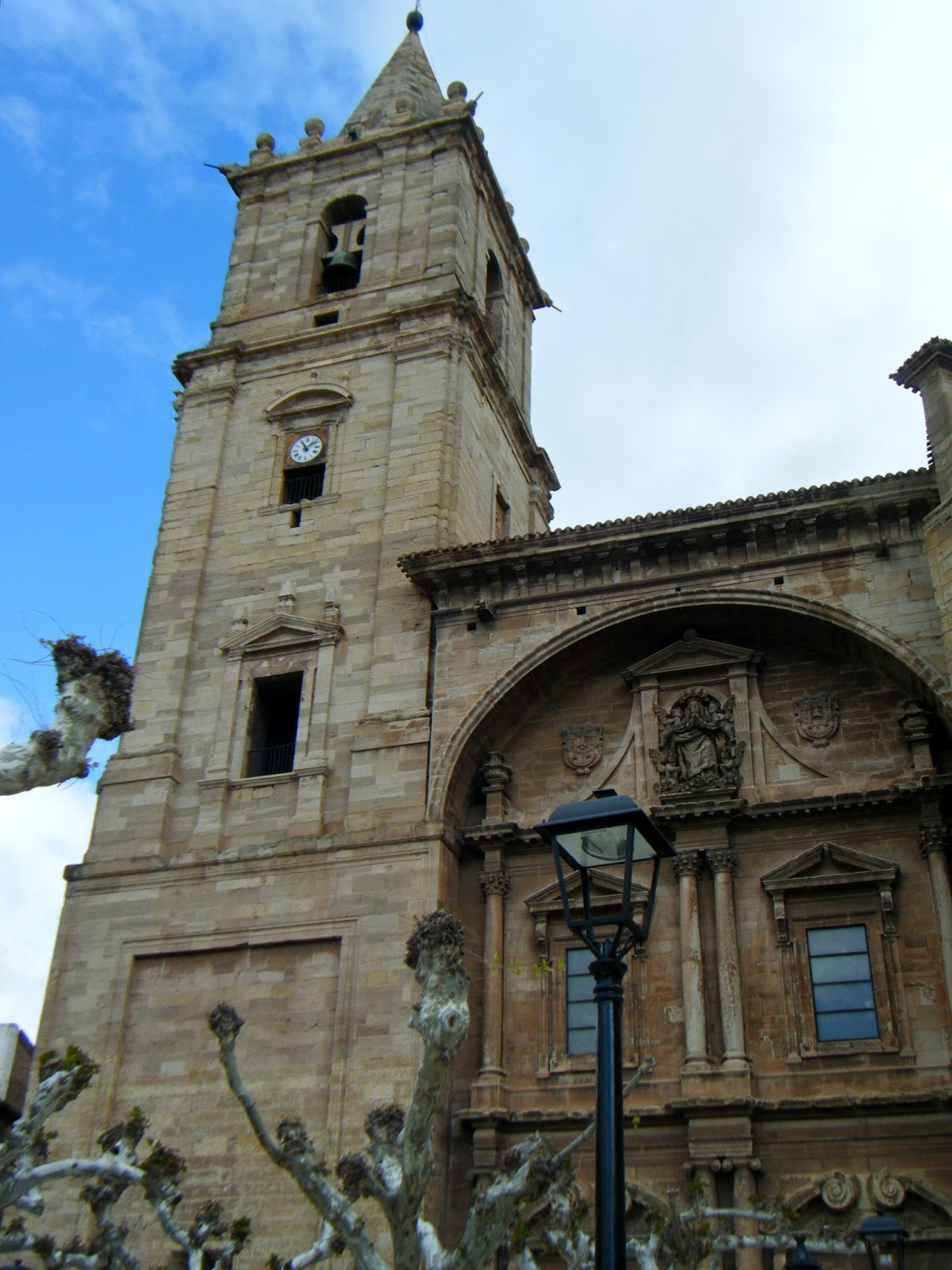
Navarette is a another traditional camino town, this one though has become prosperous through the local wine trade. A lot of effort has been made to preserve the character of the period houses, many of which bear handsomely carved family crests or shields. The town and surrounding countryside are dominated by the imposing sixteenth century Church of the Assumption, standing aloof in the top square. Because we were on a pilgrimage we felt that we should pay it a visit. Although I am not particularly religious I love the peace and quiet of churches which gave me time to meditate and reflect on my journey (or should that read - rest my feet and think about lunch).
After another coffee break, Henry went in search of the post office and I carried on alone to the small town of Ventosa where I intended to spend the night. There were large dark clouds forming overhead as I arrived at the private 'San Saturnino' albergue. It was not due to open for approximately twenty minutes and as I waited the heavens opened up with ice cold stinging hailstones, luckily I was able to shelter under the overhanging roof of an adjoining building. This was one of the most welcoming Refugio's that I stayed in along the whole camino. It was freshly decorated throughout, there was incense burning and soothing music playing quietly in the background. The tariff was very reasonable and it had all mod cons. There was also a small shop where I was able to stock up on food for the following day.
Sitting in the comfort of my living room some three months later, I can clearly see them hanging on the end of my bunk where I left them to dry. It's a pity that I didn't see them hanging there at the time because I only had one other pair with me and did not discover my loss until the following evening. Still it was the only piece of kit that I lost in five weeks, unlike Pablo who lost or mislaid an item roughly every third or fourth day. He spent an inordinate amount of time walking or travelling by bus in the opposite direction to Santiago on his expeditions to recover the latest lost item. It must have made his camino interesting, It certainly amused everybody who came into contact with him.
Our route out of Logrono took us through a linear park that led under the motorway to the shores of a reservoir surrounded by fragrantly scented pine woods. Another beautiful morning with the sun shining brightly in a clear blue sky. Unfortunately the wind had changed direction and was now coming down from the north bringing a definite arctic chill with it. So much for sunny Spain, it was warmer in the UK apparently. Henry and I enjoyed a breakfast of fresh orange juice, potato tortilla and hot cafe con leche in a small bar on the banks of this lake staring out of the picture windows at the snow capped mountains. Winter appeared to be making a return visit to Spain.
We eventually forced ourselves to go back out into the cold and carried on walking up hill within sight of the autopista to the summit of Alto de la Grajera. At the top there was a chain link fence in which earlier peregrinos had woven crosses made out of strips of bark, a by product of an adjoining timber yard. The pathway down the hill led us out of the woods and into vineyards towards the small town of Navarette. We were now in the region of La Rioja, famous for the wine of the same name. On the approach to the town we passed the ruins of an old pilgrims Hospital or refuge alongside the famous Don Jacobo wine producers. There was a sign on the fence indicating that we were still 576 kilometres from Santiago.
Another Kodak moment 'I wonder who would like that bottle of wine'.
Navarette is a another traditional camino town, this one though has become prosperous through the local wine trade. A lot of effort has been made to preserve the character of the period houses, many of which bear handsomely carved family crests or shields. The town and surrounding countryside are dominated by the imposing sixteenth century Church of the Assumption, standing aloof in the top square. Because we were on a pilgrimage we felt that we should pay it a visit. Although I am not particularly religious I love the peace and quiet of churches which gave me time to meditate and reflect on my journey (or should that read - rest my feet and think about lunch).
After another coffee break, Henry went in search of the post office and I carried on alone to the small town of Ventosa where I intended to spend the night. There were large dark clouds forming overhead as I arrived at the private 'San Saturnino' albergue. It was not due to open for approximately twenty minutes and as I waited the heavens opened up with ice cold stinging hailstones, luckily I was able to shelter under the overhanging roof of an adjoining building. This was one of the most welcoming Refugio's that I stayed in along the whole camino. It was freshly decorated throughout, there was incense burning and soothing music playing quietly in the background. The tariff was very reasonable and it had all mod cons. There was also a small shop where I was able to stock up on food for the following day.
Labels:
Camino de Santiago,
Church,
Rioja
Location:
Navarrete, La Rioja, Spain
Monday, 16 September 2013
Lost in the North Downs
Last Friday, the 13th September myself and Mrs C went to our friends wedding at a secret location somewhere in Kent. Our invitation informed us that we were to meet at 1:30 p.m. at the Premier Inn just off the A2 trunk road near Gravesend. We duly arrived in plenty of time and joined the other guests on a minibus which drove us for several miles down tree lined country lanes, getting narrower and narrower until we arrived at the venue. Nestled in a hidden valley in the heart of the North Downs was a small Norman church, all that remains of the the Lost village of Dode.
The church is 900 years old, built in the reign of William Rufus the son of William the Conqueror sometime between the years 1087 and 1100 to serve the parishioners of the village of Dode (Dowde in Old English). However nobody has worshipped at this church for more than 650 years when it was de-consecrated by the Bishop of Rochester. The reason that he carried out such a radical act was simply because there was no longer a congregation to worship here.
In 1349 the villagers were struck down by the Black Death which was ravaging Europe at the time. Brought to England in ships with unwanted stowaways, black rats carrying fleas that were infected with the plague. There was no cure for the disease and every body in the village died hideous deaths, apart from one seven year old girl. All alone, she took refuge in the church where she eventually passed away. To this day her ghost known as the 'Dode child' still haunts the church and grounds (apparently). The only spirits that I saw came out of a bottle, although on some of my photographs you can clearly see orbs; they are probably only dust motes thrown up from the straw covered floor. But who knows!
The village fell into ruin and eventually disappeared leaving nothing but the abandoned church, which over the centuries also fell into disrepair. It remained this way until ninety years ago when the ruins were purchased by a local Antiquarian who restored the building to it's former glory. These days it is very much a silent place of reflection and meditation welcoming people of all faiths and beliefs. The church is used for holding civil marriage ceremonies, christenings and the renewing of vows, while in the grounds 'wiccan' child naming and hand fasting ceremonies are held.
Dode, however is far older than the church itself, which is built on a substantial man made mound known as Holly hill, a corruption of Holy hill. It is approached by a narrow roadway which in ancient times was known as Wrangling lane indicating that the mound may have been a moot or meeting place, possibly going back thousands of years into the mists of time. Archaeological evidence shows that the site was occupied in the Roman period and then by the Saxons prior to the conquest and building of the Norman church. This is truly a mysterious and magical place. Oh, and by the way, the wedding was really great as well.
Location:
Dode Church, Luddesdown, Kent, UK
Thursday, 12 September 2013
My Camino de Santiago (Los Arcos to Logrono)
Los Arcos is a classical pilgrim stopping point half way between Estella and Logrono and goes back to the days of the Roman Empire. My albergue was located near the eastern gate into the old walled town, or it would have been if there was one. When there was a gate here, it was called the 'Portal de la Concha' or Gate of Shells, another historical reference to the camino.
Some of us met up in the town square next to the church for a few beers and something to eat. I wasn't particularly hungry so shared a plate of paella with one of my new found friends, a petite Australian lady Lucy (again name changed etc etc). She could represent her country in an eating contest; It became a feeding frenzy in which I came second, much to the amusement of everybody else. I never made that mistake again. Also the paella was cooked in squid ink, we discovered afterwards that when we smiled, we had black mouths and teeth, which again everybody found amusing.
The following morning it was raining as Henry and I left the town after a really good breakfast including home made Madeira cake, which was delicious. It carried on raining until midday and was a welcome change from the sun. We had a long walk today approximately twenty eight kilometres via the small town of Torres del Rio (Towers by the River); Another town linked with the Knight Templars, the protectors of peregrinos making their way to and from Santiago. The topography in this area consisted of a series of short steep hills which made walking a bit of a drag, going up them made your thighs and calves burn and coming down was painful on your knees.
There was a long line of peregrinos along this section of the route and we all intermingled and chatted as we struggled on with aching legs to the town of Viana for lunch. Some people decided to stay here for the night but others including myself carried on to Logrono. The sun came out during the afternoon drying us out as we walked through fields of poppies and other wild flowers to the outskirts of the city.
The approach to the city wasn't particularly pleasant, the path followed along the side of a motorway, through subways that reeked of stale urine and into an industrial area. Even the storks had taken to building their nests on electricity pylons which seems a bit of a dangerous thing to do. However once we passed through this area things greatly improved as we crossed the river into the actual city itself. I booked into the municipal albergue which resembled a refugee camp and found a bunk in one of the large dormitories.
We found a very nice bar to eat in that night and I ordered a massive plate of sausage, egg and chips and then discovered that I couldn't eat it all. My appetite appears to have shrunk since I've been in Spain, or is it all the pre-dinner beers that are filling me up. We had trouble finding our way home that evening, could it have been the alcohol or have we become unaccustomed to being in cities. Lucy declared that she was brought up in the bush and could find her way anywhere, so we promptly followed after her like sheep in the wrong direction (there are no Gum trees in Spanish cities). Luckily we came across a yellow arrow on the pavement which we followed back to the albergue, arriving just before they locked the doors for the night.
Logrono was the lowest point of my camino and is indelibly stamped on my mind for three reasons:
- The showers were freezing cold
- I picked up a stomach bug which took over a week to clear up
- When I left the following morning I left a pair of good walking trousers behind
Labels:
Australians,
Camino de Santiago,
Storks
Location:
LogroƱo, La Rioja, Spain
Subscribe to:
Posts (Atom)