Translate

Showing posts with label Church. Show all posts

Thursday, 22 May 2014

My Camino de Santiago (Carrion de los Condes)

This time last year I was walking with some of my camino friends through Galicia on our final few days into Santiago de Compostella. I have very recently had a reunion with two of our camino family and wives during which we drank and ate too much and swopped stories of our experiences and quite probably bored our wives silly. So it is time to update my Spanish pilgrimage on this blog. Okay where were we................

Our Albergue in Fromista was very basic and did not even have a kitchen but luckily it was situated next door to a small hotel with a bar and restaurant. That evening Jacques and I drank a couple of beers and dined on pizza before attempting to get some sleep which was frequently disturbed by loud snoring from one of the other inmates.

The following morning we set off bright and early and after a few kilometres stopped at a small bar for a breakfast of cafe con leche and a French omelette which was served the Spanish way in a sandwich of dry bread. For some peculiar reason it is almost impossible to get butter on your bread in this part of Spain.


Everywhere along the dirt paths we came across small craters with holes in the centre made by black ants which were about the size of wood ants that you find in pine forests in the UK. I always found these ants fascinating and quite often stopped and stared at their behaviour for several minutes at a time, any old excuse for a rest.


We had a choice of routes this morning, the direct one alongside the busy road or the longer but prettier path hugging the banks of a tranquil slow running river. We chose the latter and followed the river to the small village of Villacalzar de Sirga where we visited the church of Santa Maria la Virgen Blanca which houses the tombs of nobles and royalty. The carving above the main door was quite impressive and the church also contained a wooden frieze depicting the life of St James and how he came to be in Spain.


Our path now rejoined the primary route which we followed for several kilometres alongside of the main road to the town of Carrion de Los Condes. There are several Albergues in the town, the one that we selected was next to the church and run by an order of Nuns who were extremely welcoming to peregrinos. While we were queuing to sign in they served us with cups of tea and offered us sweets.


After taking a shower and washing our dusty clothes, Jacques and I took a stroll into the main square past a bronze statue of a medieval pilgrim. There we found a delightful little bar which sold a local delicacy; a delicious apple cake made just for sharing along with the usual beers. The town even had an outdoors shop where I was able to buy a pair of walking trousers to replace the pair that I had left in Logrono. Whilst walking back to our albergue we bumped into Amy and Lucy who were staying in a different hostel we all arranged to meet up later that evening for dinner.

Upon arriving in our albergue we had another pleasant surprise as Pablo had arrived after he had been wandering aimlessly around Northern Spain as usual, probably looking for lost possessions.
I could also hear the voice of the 'Whinging Pom' coming from the next dormitory, still sounding as if he was upset by something or other. I must have audibly voiced by annoyance at his whinging, as an Australian pilgrim who had just arrived found this quite humorous.


At 7:00 pm our group all met up at a local hotel where we ate dinner which was one of the best peregrino's meals that I had eaten so far. As we were finishing our dinner a German woman at another table stood up on her chair and serenaded us all with songs from the opera Carmen. She was very good and made several encores to rapturous applause from all the diners. It was an excellent evening all round.


Monday, 21 October 2013

A Pagan Ceremony

A few weeks ago I posted about a wedding that we were invited to at the little Norman church in the lost village of Dode. After the civil ceremony in the church the now married couple took part in a pagan celebration called a Handfasting. I had never heard of this ritual before but Mrs C who reads a lot of Mills and Boon romance novels turned out to be a bit of an expert on the subject. Apparently  handfasting goes back to Celtic times before the Romans paid us a visit and slaughtered all the Druids. The tradition carried on however and was still held as being a lawful form of marriage in Scotland until 1939.


Originally a handfasting was held to bind the couple together for the period of one year and one day as a kind of engagement or trial marriage to see if they could get along together. After this time had elapsed they would either decide to call it a day and go their separate ways or return to the sacred site to be handfasted together for life. This period of a year and a day appears to be symbolic in British law as it is also recognised in cases of murder. If the victim is assaulted and dies within this time then the assailant can be charged with their murder (I'm sure that there is no connection here).


The hand fasting ceremony is usually held out side preferably at a place of great religious significance to the Celts such as a sacred grove of trees or a stone circle. There is a stone circle at Dode which looks similar to ancient ones but is in fact only a few years old. However the stones were carefully selected from a local quarry, each was given a mystical name and the circle was laid down and blessed in a pagan ritual. Although the stones look shiny and new at the moment, after a few more years of weathering they will look as though they have been part of the landscape since the iron age (this should cause some confusion to archaeologists in the future).

Prior to the commencement of the celebration all the wedding guests formed a large circle around the Bride and Groom within the confines of the stones. A circle is a very significant symbol in the ceremony as it represents eternity, a sign that life, love and happiness have no beginning and no end. Two men from the congregation were chosen to protect the circle, in ancient times they would have probably been warriors but our chosen ones looked more like civil servants or computer geeks (Luckily our circle wasn't under any kind of threat). They were both given ceremonial daggers and patrolled around the circle opposite each other keeping  all within safe throughout the handfasting.


The ceremony then began with the priest calling on the guardians of the four Cardinal points of the compass representing the four elements, to bless the couple and congregation starting with the East, as this is the direction from which the sun rises. The four elements are East (Fire), South (Air), West (Water) and North (Earth). The couple then clasped hands and the priest asked them a series of questions, as they answered each one he looped a cord around their hands eventually tying it off in a knot. They then shared a drink from a pewter goblet sealing their handfasting.


This particular ceremony ended with the couple jumping over a broom stick which symbolised them sweeping away the past and starting their married life together. If they wished they could have jumped across a sword as well as the broom stick. The sword represents the masculine protector and the broom stick the feminine home maker. Apparently there are several variations on the actual words used in the handfasting ceremony and the one that I witnessed was originally used in Victorian times. It was a really cool thing to witness and as it predates christianity I felt that this ceremony probably holds more significance to many people than the civil ceremony. It was more interesting that is for certain. I wonder if we will be invited back after a year and a day!


Sunday, 6 October 2013

My Camino de Santiago ( Ghost town and Chicken dinners)

I woke up exhausted after starring in that classic film remake 'Sleepless in Azofra'. My lack of sleep  was brought on by the stomach bug that I picked up in Logrono, or was it last nights bottles of cheap vino collapso. Either way I didn't bother with breakfast so was marching on an empty stomach. Even in this state and carrying a full pack I was still managing to walk at a rate of one kilometre every twelve and a half minutes, not bad going for day nine. It's like they used to say in the Army it's a question of 'mind over matter' that is the Army doesn't mind and you don't matter, whatever, it certainly works.

It was raining all night so Henry and I were walking through red mud which clung to our boots making each step harder than it should have been. At about lunch time we came to a new urbanisation  on the outskirts of  the tiny village of Ciruena. The streets and houses were very neat and tidy and would have been an idyllic place to live, particularly if you played golf, as the estate was adjacent to an eighteen hole golf course.

Unfortunately the builders must have completed this project just as the global recession hit Spain because only one or two houses in each street were occupied the rest were boarded up and sporting 'For Sale' signs. Henry and I wandered through these streets together thinking that we had entered some sort post apocalyptic ghost town. The streets were eerily deserted with absolutely no sign of life, not even the warning bark of chained up dogs which we had grown accustomed to when walking into Spanish villages.


As we entered the old village we passed the albergue and commented that it looked really run down and decrepit. Later that day we bumped into a fellow peregrino who had spent the night there and she described it as an absolute hell hole. It was apparently freezing cold, there were no blankets, no facilities to cook a meal and the Hospitalero was very unfriendly bordering on hostile. She said that if it was not for some other really nice pilgrims arriving she would have walked out even though she was really tired and it was several kilometres to the next refuge.


We walked fifteen kilometres today to the town of Santo Domingo de la Calzada where we booked into the municipal albergue which was close to the Cathedral. After taking a shower and washing my clothes I was resting in the communal area when a few other peregrinos who we knew arrived, they included Lucy and Pablo who had travelled by bus as his injured leg was playing up a bit. That night we all shared a wonderful meal together washed down by wine, however I must be really feeling out of sorts because I only drank water.


The town of Santo domingo owes it's inspiration to Saint Dominic of the road who lived here in the eleventh century after being evicted from the monastery for being illiterate. Because of this he dedicated his life to improving the pilgrims route and was responsible for building many of the roads and bridges which we have travelled along. He built a pilgrims hospital which is now the Parador and also a church which over the centuries evolved into the Cathedral. Both buildings are situated in the historic town square the Plaza del Santo. I decided to visit the Cathedral which is another one of the iconic landmarks of the Camino Frances. The building and adjoining museum contain many beautiful religious artefacts but more importantly I wished to see the cockerel and hen which are kept in a coop in the rear of the church.


The chicken coop relates to the story of the cock which is one of the more endearing stories of the camino. Legend has it that during the middle ages a German couple on camino with their son stopped at a nearby inn for the night. The Inn keepers daughter apparently fell in love with the son who being devout, rejected her advances. So in a fit of anger she hid a silver goblet in his backpack then reported him for the theft. The innocent boy was hanged for this crime and his parents oblivious to his fate carried onto Santiago. On their way home they once again came to the town where they found their son still hanging on the gallows but miraculously still alive thanks to the intervention of Santo Domingo. The couple rushed to the sheriffs house and found him just about to tuck into a roast chicken dinner. They told him the news and he retorted that their son was no more alive than the chicken that he was about to eat. At this the cockerel came to life, stood up and crowed loudly. The sheriff was so impressed with this miracle that he had the boy cut down and given a full pardon.


In honour of Santo Domingo and the miracle of the cockerel our communal meal that evening was chicken. However in order to stop it jumping off of the plate and crowing loudly we cut it into pieces, coated it in flour and deep fried it and as they say in Kentucky it was finger licking good.


Thursday, 19 September 2013

My Camino de Santiago (La Rioja and lost things)

Each morning whilst on camino you follow roughly the same routine. First swear very loudly at the early risers who rudely turn the lights on and bang around, making no attempt to be considerate for those still trying to sleep. Then you get washed etc and pack up your sleeping bag and belongings into your rucksack, before looking for somewhere to eat breakfast. The morning that I left Logrono I was a bit distracted, it was probably the stomach bug that I appeared to have picked up over night. The knock on effect of this is that I left my spare walking trousers behind in the albergue.

 Sitting in the comfort of my living room some three months later, I can clearly see them hanging on the end of my bunk where I left them to dry. It's a pity that I didn't see them hanging there at the time because I only had one other pair with me and did not discover my loss until the following evening. Still it was the only piece of kit that I lost in five weeks, unlike Pablo who lost or mislaid an item roughly every third or fourth day. He spent an inordinate amount of time walking or travelling by bus in the opposite direction to Santiago on his expeditions to recover the latest lost item. It must have made his camino interesting, It certainly amused everybody who came into contact with him.


This wall art is appropriate for Pablo.


Our route out of Logrono took us through a linear park that led under the motorway to the shores of a reservoir surrounded by fragrantly scented pine woods. Another beautiful morning with the sun shining brightly in a clear blue sky. Unfortunately the wind had changed direction and was now coming down from the north bringing a definite arctic chill with it. So much for sunny Spain, it was warmer in the UK apparently. Henry and I enjoyed a breakfast of fresh orange juice, potato tortilla and hot cafe con leche in a small bar on the banks of this lake staring out of the picture windows at the snow capped mountains. Winter appeared to be making a return visit to Spain.


Across the vineyards, looking towards the small town of Navarette.


We eventually forced ourselves to go back out into the cold and carried on walking up hill within sight of the autopista to the summit of Alto de la Grajera. At the top there was a chain link fence in which earlier peregrinos had woven crosses made out of strips of bark, a by product of an adjoining timber yard. The pathway down the hill led us out of the woods and into vineyards towards the small town of Navarette. We were now in the region of La Rioja, famous for the wine of the same name. On the approach to the town we passed the ruins of an old pilgrims Hospital or refuge alongside the famous Don Jacobo wine producers. There was a sign on the fence indicating that we were still 576 kilometres from Santiago.


Another Kodak moment 'I wonder who would like that bottle of wine'.


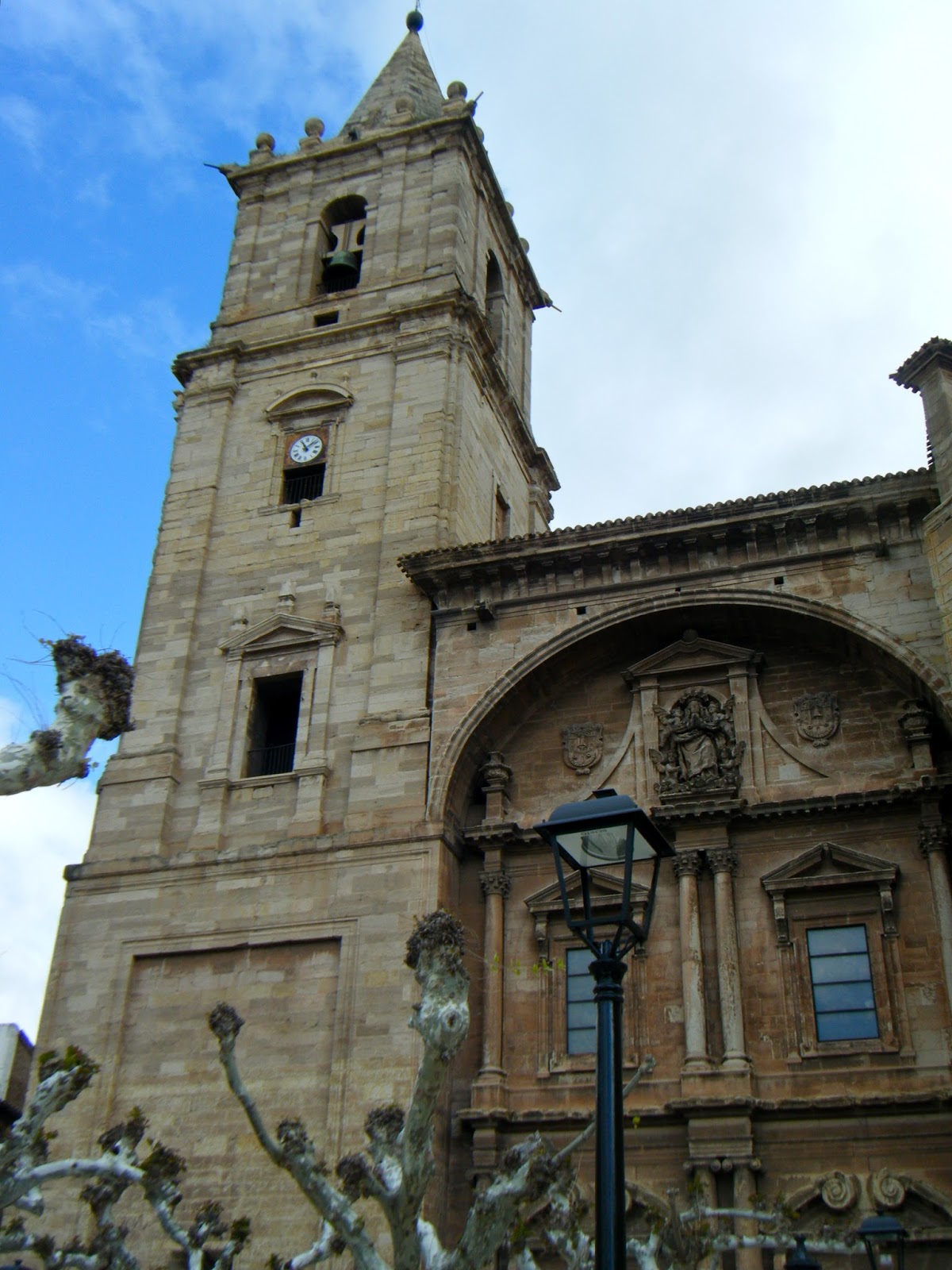
Navarette is a another traditional camino town, this one though has become prosperous through the local wine trade. A lot of effort has been made to preserve the character of the period houses, many of which bear handsomely carved family crests or shields. The town and surrounding countryside are dominated by the imposing sixteenth century Church of the Assumption, standing aloof in the top square. Because we were on a pilgrimage we felt that we should pay it a visit. Although I am not particularly religious I love the peace and quiet of churches which gave me time to meditate and reflect on my journey (or should that read - rest my feet and think about lunch).


After another coffee break, Henry went in search of the post office and I carried on alone to the small town of Ventosa where I intended to spend the night. There were large dark clouds forming overhead as I arrived at the private 'San Saturnino' albergue. It was not due to open for approximately twenty minutes and as I waited the heavens opened up with ice cold stinging hailstones, luckily I was able to shelter under the overhanging roof of an adjoining building. This was one of the most welcoming Refugio's that I stayed in along the whole camino. It was freshly decorated throughout,  there was incense burning and soothing music playing quietly in the background. The tariff was very reasonable and it had all mod cons. There was also a small shop where I was able to stock up on food for the following day.


Monday, 16 September 2013

Lost in the North Downs

Last Friday, the 13th September myself and Mrs C went to our friends wedding at a secret location somewhere in Kent. Our invitation informed us that we were to meet at 1:30 p.m. at the Premier Inn just off the A2 trunk road near Gravesend. We duly arrived in plenty of time and joined the other guests on a minibus which drove us for several miles down tree lined country lanes, getting narrower and narrower until we arrived at the venue. Nestled in a hidden valley in the heart of the North Downs was a small Norman church, all that remains of the the Lost village of Dode.


The church is 900 years old, built in the reign of William Rufus the son of William the Conqueror sometime between the years 1087 and 1100 to serve the parishioners of the village of Dode (Dowde in Old English). However nobody has worshipped at this church for more than 650 years when it was de-consecrated by the Bishop of Rochester. The reason that he carried out such a radical act was simply because there was no longer a congregation to worship here.


In 1349 the villagers were struck down by the Black Death which was ravaging Europe at the time. Brought to England in ships with unwanted stowaways, black rats carrying fleas that were infected with the plague. There was no cure for the disease and every body in the village died hideous deaths, apart from one seven year old girl. All alone, she took refuge in the church where she eventually passed away. To this day her ghost known as the 'Dode child' still haunts the church and grounds (apparently). The only spirits that I saw came out of a bottle, although on some of my photographs you can clearly see orbs; they are probably only dust motes thrown up from the straw covered floor. But who knows!


The village fell into ruin and eventually disappeared leaving nothing but the abandoned church, which over the centuries also fell into disrepair. It remained this way until ninety years ago when the ruins were purchased by a local Antiquarian who restored the building to it's former glory. These days it is very much a silent place of reflection and meditation welcoming people of all faiths and beliefs. The church is used for holding civil marriage ceremonies, christenings and the renewing of vows, while in the grounds 'wiccan' child naming and hand fasting ceremonies are held.


Dode, however is far older than the church itself, which is built on a substantial man made mound known as Holly hill, a corruption of Holy hill. It is approached by a narrow roadway which in ancient times was known as Wrangling lane indicating that the mound may have been a moot or meeting place, possibly going back thousands of years into the mists of time. Archaeological evidence shows that the site was occupied in the Roman period and then by the Saxons prior to the conquest and building of the Norman church. This is truly a mysterious and magical place. Oh, and by the way, the wedding was really great as well.


Wednesday, 21 August 2013

Barrows, Shucks and Bravery

After a week of (not so) hard labour, Little dog has been given time off for good behaviour. She is now out on parole, so we decided to revisit Wilmington and the Long Man. I had seen several references to long barrows and tumuli marked on the map in the vicinity of the giant which I wanted to take a look at. Little dog just wanted to run around and enjoy herself after her recently self imposed incarceration.

A long barrow is a bronze age burial mound usually for a chieftain or somebody of high status and a tumuli is a smaller grave. The most prominent barrow is on the top of Windover Hill above the head of the Long Man, it is approximately twenty metres long and is surrounded by a ditch. According to local folklore this barrow is the giants actual grave, he was killed after having a fight with another giant who lived on Firle Beacon a few miles away. The chalk figure outline was made as a memorial to him  apparently. Just below the barrow are several other smaller mounds and round trenches these are the spoil heaps and remains of neolithic flint mining.


Long Barrow on Windover Hill above the Long Man


Another view of the Long Man at Wilmington


Little dog did not take much interest in these bronze age remains, she had discovered a rabbit hole which was much more exciting. It appeared to go down vertically into the ground and reminded me of the rabbit hole that Alice went down on her visit to Wonderland. Judging from the size of the entrance it must have housed some very large rabbits.


Is this the den of a Shuck or of giant rabbits

Or could this have been the den of a 'Shuck' which according to legend is a large black ghostly dog that is supposed to haunt Windover Hill. Apparently shucks are shaggy phantom dogs about the size of a calf and they are associated with ancient trackways and ley lines. There just so happens to be an ancient trackway running across the hill and a ley line running from the barrow, through the Long Man to the church in Wilmington. Some shucks are supposed to be a portent of impending doom and others apparently guard the sites of hidden treasure. Little dog was doing her best to impersonate a shuck by rolling in something horrible giving her the appearance and smell of a demonic hound.


Ancient trackway looking towards Firle Beacon


We left Windover hill by means of an ancient trackway and as we turned a corner, there coming towards us was a shuck. Actually there were about thirty shucks, they were large black and shaggy about the size of a calf (some were the size of a cow). "Bollocks" I thought "I bet we're standing on a ley line as well". The thing about these shucks was that they didn't appear to be particularly canine in appearance, they were more bovine. Whatever, they certainly  appeared to be the portent of our impending doom.


A herd of black shaggy shucks, the portent of our doom (possibly)


We were on a section of track that dropped off like a cliff face on one side and had a steep bank on the other. Little dog bravely hid behind my legs as this gang of marauding cattle decided that they had right of way and were going to partake of that right no matter what. Something had to be done and fast; suddenly like those faithful canine companions of film and television, Lassie, Rin Tin Tin and Snowy, Little dog launched herself in front of this seething mass of bovine muscle (or rather she didn't, I launched her with a size nine up her backside).


A faithful canine companion, doing her stuff


Then a very strange and unexpected thing happened, the cows stopped as one and started to look a little worried. "We didn't expect him to throw a dog at us, that's not playing fair". Two of the braver cows were pushed to the front by their compatriots and held a brief parlais with Little dog. After a short 'Mexican standoff' the cows 'bottled it' and as if by a miracle the herd parted to let us pass. "That showed them eh! Little dog, double rations for you tonight".


Tea and Medals with The Queen for a Brave 'Little dog'


Note: This is the last post for about ten days as Mrs C and I are off to sunny Spain and Little dog is going to Grandma's for a bit of Rest and Recuperation after her recent adventures. She will be spoilt rotten, spending most of her day lying on the sofa being fed biscuits and grapes.


Wednesday, 14 August 2013

My Camino de Santiago (Onward and Upwards)

Another early start. First stop was at a bar about fifty metres from the albergue for the usual coffee and croissant to wake me up. Now fully awake and refreshed, I followed a long crocodile of peregrinos out of Pamplona through a well manicured linear park; coming towards us was an equally long crocodile of joggers. The horizon ahead of us was filled by a long flat hill with a thick white cloud sitting across its summit like a table cloth. Oh Joy! we would be climbing this in a few hours time, and it was already beginning to get very warm.


We had a very pleasant stroll along a gently ascending path towards the foot of the long ridge, it's summit decorated with a row of wind turbines. On the way I stopped for a short rest next to a wayside shrine dedicated to a Belgian peregrino who had died after suffering a heart attack a few years earlier. This was just one of many others that I would pass along the camino over the following weeks. As a sign of remembrance I deposited a small stone on the shrine. This is a practice that I first discovered whilst visiting war graves on the Western Front a few years ago (apparently it is a Jewish tradition). I think that it is a wonderfully poignant way of showing other visitors that this person is not forgotten.


The sun was beating down upon us as we struggled with our heavy rucksacks to the top of what had now become a very steep hill. On 'The Way of St James', they talk about Camino Angels, who appear when you are at your lowest ebb and provide you with help or the thing that you need most. On the summit of the Alto Del Perdon, the name of this hill, I found my first Camino Angel in the form of a local man who was selling ice cold beers. Suitably refreshed I took my turn posing in front of a large sculpture of medieval peregrinos and their animals leaning into the westerly wind. It is called "Where the path of the wind crosses the stars" and is one of the iconic landmarks along the Camino Frances.


From the narrow summit of the Alto Del Perdon, I could see my destination for the evening, the small town of Puente La Reina; several miles in the distance, across a patchwork of fields. After walking for a few miles I left the designated route to visit the church at Eunate set amongst fields of oilseed rape. This detour turned out to be further than I had anticipated but was well worth the extra effort getting there. Unfortunately though with the sun still blazing down out of a cloudless sky I ended up suffering from sunburn on my left arm.


When I reached the church which was built in the 12th century by the Knight Templars, it was closed. However there were several Australian pilgrims sitting outside who assured me that it was due to open in about thirty minutes. One hour later a car pulled up and the church warden got out and quietly unlocked the door. The church is horizontal in shape with a free standing porch surrounding it. Inside it was very peaceful and pleasantly cool; decorated with a small altar upon which stood a statue of the Madonna and child. While I sat quietly admiring the simplicity of the church, around me several people were kneeling in prayer or taking photographs.


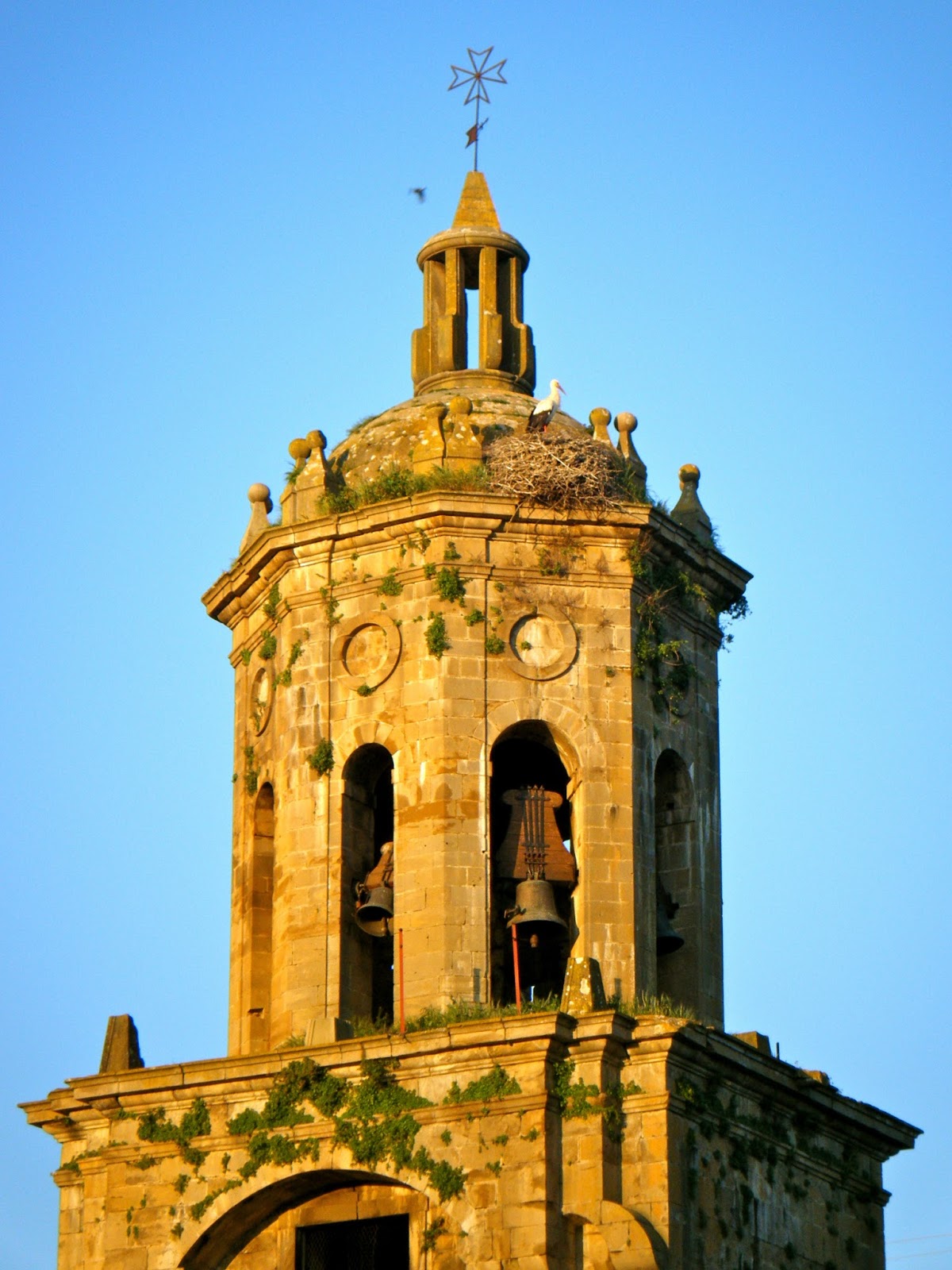
Gradually we left the church and got our credencials stamped by the warden who warned us about leaving our rucksacks unattended, as there have been a lot of thefts since the recession hit Spain. We then walked together for the last few miles along the main road to the municipal albergue in Puente La Reina (The Queens Bridge). Opposite the albergue stands an old stone church with several storks nesting on the roof of its tower. That evening several of us got together and enjoyed a communal meal that we prepared ourselves, washed down with the local red wine. It can be extremely tough on the camino. Never mind tomorrow is another day!