Little dog is chin-strapped! She is asleep beside me on the sofa covered with my old fleece jacket, snoring gently. She will probably spend the next two to three days comatose, only getting up for her meals and the occasional call of nature. The reason for her being in this state is that we went for a long walk across the South Downs today. Little dog is not as young as she used to be but she won't let a little thing like her age prevent her from joining me on a long walk. In fact if I went without her she would spend the day sulking and being a nuisance to Mrs C, who would behave in a similar fashion if I dragged her for ten miles across the Downs in this weather.
Talking about the weather, the Met office forecast said that the rain would stop at lunch time yesterday and the rest of the weekend would be clear and sunny. They got that seriously wrong! The sun was shining yesterday and today it's been raining all day long. Still I've been promising Little dog a long walk all week and it will give me a chance to try out my newish light weight waterproof jacket. I bought it earlier in the summer to replace the jacket that I left in the donativo box in an albergue in Spain after it leaked one too many times.
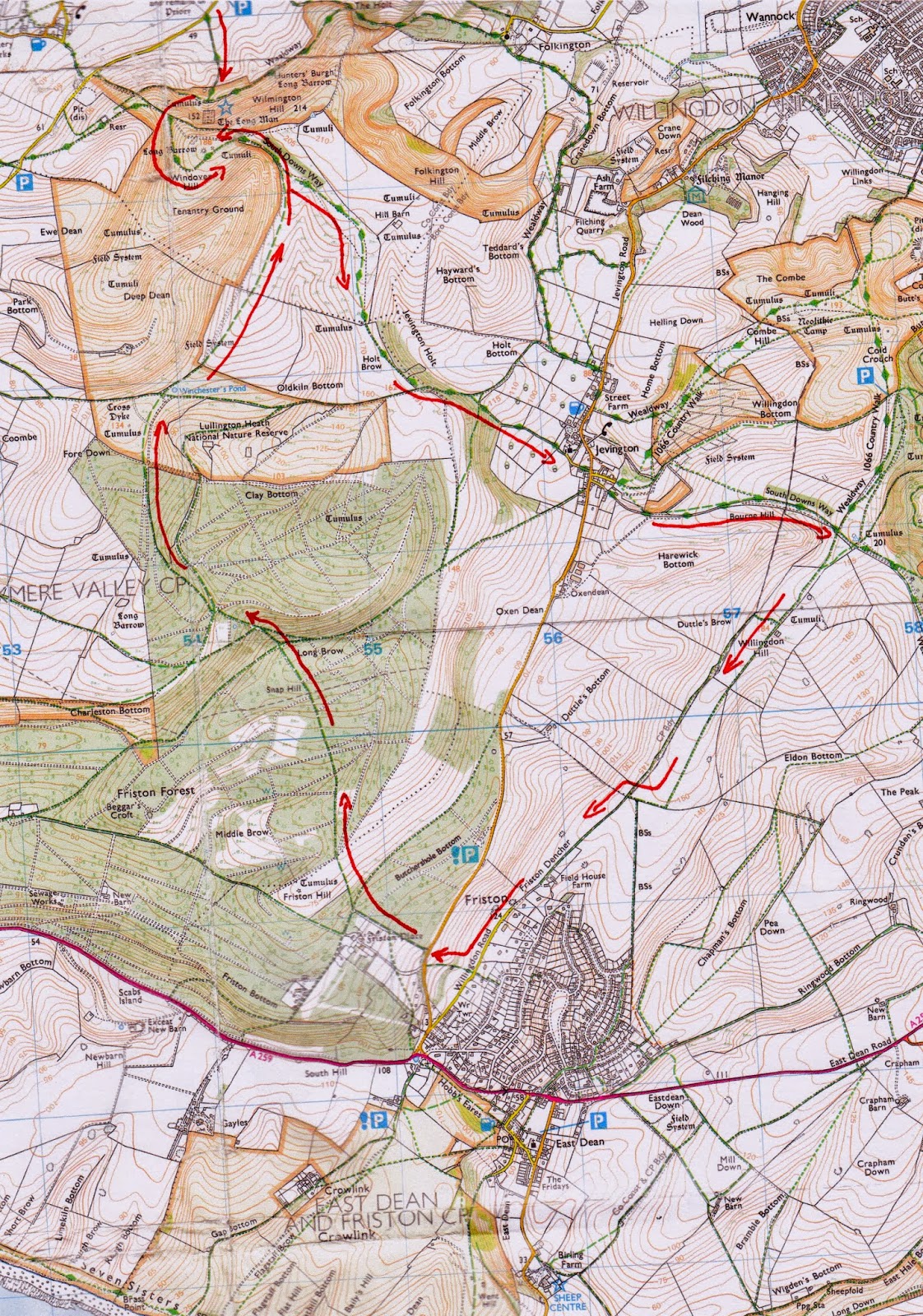
We started the walk from the Long Man car park at Wilmington at 10:00 am and it was already raining steadily. There was only one other car in the car park, the driver was from a rambling club awaiting his compatriots who should have arrived thirty minutes earlier. They had apparently made the decision to stay in bed and forgot to inform him, either that or they don't like him. There was low cloud blanketing the top of the Downs above the Long Man as we set off, a bit different from the last time we were here a few weeks ago.
Our route led us in an anti-clockwise direction around the base of the Long Man and up onto Windover hill. There were no 'shucks' or cows here today, they had apparently sought out the relative shelter of the valley bottoms. I had to scramble up a short section of chalk path which had been polished smooth by constant use, it was like walking on ice. I nearly fell over on several occasions but Little dog had no problems with her four foot drive and crampons on the end of her paws. At the top we met three Australian women who were on the last day of their eight day walk along the South Downs way. After a brief exchange of pleasantries I left them standing in the murk as Little dog and I followed the fence line up to the Trig point at the top of the hill.
After locating our exact position we back tracked 100 metres to another fence line which ran parallel to the route of the South Downs way. We followed this fence through the mist, passing the ghostly bodies of sheep looming out of the cloud. Eventually coming to a wood where we picked up a track that led us down to the village of Jevington, the birth place of the Bannofee pie.
Just outside of the village we met the Australian ladies again who were looking a little lost. They were trying to find the village of West Dean but had missed their turn off and were about three miles off course. I walked with them into the village and gave them directions to Eastbourne via the alternate route of the SDW. Little dog and I carried on walking to the top of Bourne hill whilst they went to the pub for a cup of coffee. Upon reaching the top of the hill we turned right and walked two miles to the outskirts of Friston.
My new jacket was holding up well to the constant down pour although I was still wet from perspiration. Little dog was soaked through but still happily wagging her tail. Our route took us into Friston Forest where we stopped under cover of a beech tree for lunch. Little dog may be small but she managed to devour half of my Cornish pastie in double quick time.
A short while later we came to a small clearing where several paths went off in different directions, some of them weren't even marked on the map. One of the Camino Angels must have followed me back to Blighty because while trying to work out my route I discovered two yellow arrows painted on the ground pointing our way. We followed the slippery muddy path uphill into Lullington Heath nature reserve but the only signs of life that we saw were sheep and rooks. In the distance about two kilometres away I could see the Long Barrow on top of Windover hill above the Long Man .
Forty minutes later we were back at the foot of the Long Man where the fields were full of Canada geese feeding in the stubble of the cropped wheat. A few hundred metres more and we were back in the car park and out of the rain. It was now 2:15 pm and apart from a ten minute break for lunch we had been walking constantly for four hours into the non stop rain. Little dog slept throughout the drive home and is now chasing rabbits in her dreams. I'm enjoying a much needed refreshing mug of English Breakfast Tea. A brief look at our route on the map tells me that we have walked approximately ten miles today. Not bad really for a little old Spaniel.
Note: For those of you who have never served in the Army, the term chin-strapped refers to a soldier being so tired that he is only being held upright by the chin strap of his helmet.
Translate
Showing posts with label The Long Man. Show all posts
Sunday, 13 October 2013
Wednesday, 21 August 2013
Barrows, Shucks and Bravery
After a week of (not so) hard labour, Little dog has been given time off for good behaviour. She is now out on parole, so we decided to revisit Wilmington and the Long Man. I had seen several references to long barrows and tumuli marked on the map in the vicinity of the giant which I wanted to take a look at. Little dog just wanted to run around and enjoy herself after her recently self imposed incarceration.
A long barrow is a bronze age burial mound usually for a chieftain or somebody of high status and a tumuli is a smaller grave. The most prominent barrow is on the top of Windover Hill above the head of the Long Man, it is approximately twenty metres long and is surrounded by a ditch. According to local folklore this barrow is the giants actual grave, he was killed after having a fight with another giant who lived on Firle Beacon a few miles away. The chalk figure outline was made as a memorial to him apparently. Just below the barrow are several other smaller mounds and round trenches these are the spoil heaps and remains of neolithic flint mining.
Long Barrow on Windover Hill above the Long Man
Another view of the Long Man at Wilmington
Little dog did not take much interest in these bronze age remains, she had discovered a rabbit hole which was much more exciting. It appeared to go down vertically into the ground and reminded me of the rabbit hole that Alice went down on her visit to Wonderland. Judging from the size of the entrance it must have housed some very large rabbits.
Is this the den of a Shuck or of giant rabbits
Or could this have been the den of a 'Shuck' which according to legend is a large black ghostly dog that is supposed to haunt Windover Hill. Apparently shucks are shaggy phantom dogs about the size of a calf and they are associated with ancient trackways and ley lines. There just so happens to be an ancient trackway running across the hill and a ley line running from the barrow, through the Long Man to the church in Wilmington. Some shucks are supposed to be a portent of impending doom and others apparently guard the sites of hidden treasure. Little dog was doing her best to impersonate a shuck by rolling in something horrible giving her the appearance and smell of a demonic hound.
Ancient trackway looking towards Firle Beacon
We left Windover hill by means of an ancient trackway and as we turned a corner, there coming towards us was a shuck. Actually there were about thirty shucks, they were large black and shaggy about the size of a calf (some were the size of a cow). "Bollocks" I thought "I bet we're standing on a ley line as well". The thing about these shucks was that they didn't appear to be particularly canine in appearance, they were more bovine. Whatever, they certainly appeared to be the portent of our impending doom.
A herd of black shaggy shucks, the portent of our doom (possibly)
We were on a section of track that dropped off like a cliff face on one side and had a steep bank on the other. Little dog bravely hid behind my legs as this gang of marauding cattle decided that they had right of way and were going to partake of that right no matter what. Something had to be done and fast; suddenly like those faithful canine companions of film and television, Lassie, Rin Tin Tin and Snowy, Little dog launched herself in front of this seething mass of bovine muscle (or rather she didn't, I launched her with a size nine up her backside).
A faithful canine companion, doing her stuff
Then a very strange and unexpected thing happened, the cows stopped as one and started to look a little worried. "We didn't expect him to throw a dog at us, that's not playing fair". Two of the braver cows were pushed to the front by their compatriots and held a brief parlais with Little dog. After a short 'Mexican standoff' the cows 'bottled it' and as if by a miracle the herd parted to let us pass. "That showed them eh! Little dog, double rations for you tonight".
Tea and Medals with The Queen for a Brave 'Little dog'
Note: This is the last post for about ten days as Mrs C and I are off to sunny Spain and Little dog is going to Grandma's for a bit of Rest and Recuperation after her recent adventures. She will be spoilt rotten, spending most of her day lying on the sofa being fed biscuits and grapes.
A long barrow is a bronze age burial mound usually for a chieftain or somebody of high status and a tumuli is a smaller grave. The most prominent barrow is on the top of Windover Hill above the head of the Long Man, it is approximately twenty metres long and is surrounded by a ditch. According to local folklore this barrow is the giants actual grave, he was killed after having a fight with another giant who lived on Firle Beacon a few miles away. The chalk figure outline was made as a memorial to him apparently. Just below the barrow are several other smaller mounds and round trenches these are the spoil heaps and remains of neolithic flint mining.
Long Barrow on Windover Hill above the Long Man
Another view of the Long Man at Wilmington
Little dog did not take much interest in these bronze age remains, she had discovered a rabbit hole which was much more exciting. It appeared to go down vertically into the ground and reminded me of the rabbit hole that Alice went down on her visit to Wonderland. Judging from the size of the entrance it must have housed some very large rabbits.
Is this the den of a Shuck or of giant rabbits
Or could this have been the den of a 'Shuck' which according to legend is a large black ghostly dog that is supposed to haunt Windover Hill. Apparently shucks are shaggy phantom dogs about the size of a calf and they are associated with ancient trackways and ley lines. There just so happens to be an ancient trackway running across the hill and a ley line running from the barrow, through the Long Man to the church in Wilmington. Some shucks are supposed to be a portent of impending doom and others apparently guard the sites of hidden treasure. Little dog was doing her best to impersonate a shuck by rolling in something horrible giving her the appearance and smell of a demonic hound.
Ancient trackway looking towards Firle Beacon
We left Windover hill by means of an ancient trackway and as we turned a corner, there coming towards us was a shuck. Actually there were about thirty shucks, they were large black and shaggy about the size of a calf (some were the size of a cow). "Bollocks" I thought "I bet we're standing on a ley line as well". The thing about these shucks was that they didn't appear to be particularly canine in appearance, they were more bovine. Whatever, they certainly appeared to be the portent of our impending doom.
A herd of black shaggy shucks, the portent of our doom (possibly)
We were on a section of track that dropped off like a cliff face on one side and had a steep bank on the other. Little dog bravely hid behind my legs as this gang of marauding cattle decided that they had right of way and were going to partake of that right no matter what. Something had to be done and fast; suddenly like those faithful canine companions of film and television, Lassie, Rin Tin Tin and Snowy, Little dog launched herself in front of this seething mass of bovine muscle (or rather she didn't, I launched her with a size nine up her backside).
A faithful canine companion, doing her stuff
Then a very strange and unexpected thing happened, the cows stopped as one and started to look a little worried. "We didn't expect him to throw a dog at us, that's not playing fair". Two of the braver cows were pushed to the front by their compatriots and held a brief parlais with Little dog. After a short 'Mexican standoff' the cows 'bottled it' and as if by a miracle the herd parted to let us pass. "That showed them eh! Little dog, double rations for you tonight".
Tea and Medals with The Queen for a Brave 'Little dog'
Note: This is the last post for about ten days as Mrs C and I are off to sunny Spain and Little dog is going to Grandma's for a bit of Rest and Recuperation after her recent adventures. She will be spoilt rotten, spending most of her day lying on the sofa being fed biscuits and grapes.
Labels:
Church,
Little dog,
The Long Man,
The South Downs,
Wilmington
Location:
Wilmington, East Sussex BN26, UK
Monday, 12 August 2013
The Long Man
We've been out and about in the Ashdown Forest rather a lot recently, so today I decided that Little dog needed a change of scenery for her daily perambulation. There is a range of hills a few miles to the south of my home called the South Downs (a strange name as they are all ups). They start near Winchester in Hampshire (King Alfred the Greats Capitol city of Wessex) and run eastwards for approximately 100 miles to Eastbourne where they drop abruptly into the English Channel at Beachy Head.
Wheat fields following the escarpment of the South Downs in East Sussex
We, or rather I, (Little dog doesn't get a vote) decided to pay these magnificent hills a visit as we haven't been there since the beginning of the year when it was cold and frosty. Today is a beautiful sunny day with large cumulus clouds filling the sky, so I thought that this would be a good time to pay our respects to 'The Long Man' and hopefully take some half decent photographs. After a very pleasant drive through the country lanes of East Sussex we arrived at our destination, where all hell breaks loose as Little dog desperately attempts to get out of the car and begin her walk.
The Long Man is a 70 metre tall figure cut into the chalk escarpment with both arms outstretched and holding a long stave in each hand. He is situated on the north side of Windover hill overlooking the peaceful little village of Wilmington with it's Norman church and old Benedictine priory. There is a lot of conjecture as to who carved the figure. Originally it was thought to be from the bronze age as there is a Long Barrow nearby and a few miles away on Mount Caburn stands an ancient hill fort. Another theory is that the benedictine monks may have carved it, but this is thought unlikely as the figure is naked.
The Long Man Summer and Winter
The earliest written record of this figure goes back to 1710 when it was known locally as the Green man because the outline was just an indentation in the turf of the hillside. It was renovated by the Sussex Archaeological Survey in 1874 making the figure more visible by covering the outline with yellow bricks, these were later replaced by white concrete blocks in 1969. It is thought that during the renovation work the direction of the feet were changed, because an earlier record states that they both pointed outwards giving the appearance that the giant was walking down the hill. This was later confirmed by geo-physical survey.
Wilmington viewed from Windover Hill
Across the wheat fields towards Firle Beacon
Little dog and I spent a good couple of hours walking and taking photographs around the Long Man and she was very well behaved throughout, probably because I was standing on her throat whilst attempting to take my photographs (only joking no animals were harmed in the making of this blog).
Before heading for home we enjoyed a nice cup of tea and a fight over some hob-nob biscuits together. If anybody is out and about in East Sussex, the Long man is thoroughly worth a visit and if that doesn't inspire you then there are some really quaint Pubs in the local villages all along the foot of the Downs which sell excellent ales and food (that's my bit of free advertising for the East Sussex Tourist Board and Licensed Victuallers Association).
Wheat fields following the escarpment of the South Downs in East Sussex
We, or rather I, (Little dog doesn't get a vote) decided to pay these magnificent hills a visit as we haven't been there since the beginning of the year when it was cold and frosty. Today is a beautiful sunny day with large cumulus clouds filling the sky, so I thought that this would be a good time to pay our respects to 'The Long Man' and hopefully take some half decent photographs. After a very pleasant drive through the country lanes of East Sussex we arrived at our destination, where all hell breaks loose as Little dog desperately attempts to get out of the car and begin her walk.
The Long Man is a 70 metre tall figure cut into the chalk escarpment with both arms outstretched and holding a long stave in each hand. He is situated on the north side of Windover hill overlooking the peaceful little village of Wilmington with it's Norman church and old Benedictine priory. There is a lot of conjecture as to who carved the figure. Originally it was thought to be from the bronze age as there is a Long Barrow nearby and a few miles away on Mount Caburn stands an ancient hill fort. Another theory is that the benedictine monks may have carved it, but this is thought unlikely as the figure is naked.
The Long Man Summer and Winter
The earliest written record of this figure goes back to 1710 when it was known locally as the Green man because the outline was just an indentation in the turf of the hillside. It was renovated by the Sussex Archaeological Survey in 1874 making the figure more visible by covering the outline with yellow bricks, these were later replaced by white concrete blocks in 1969. It is thought that during the renovation work the direction of the feet were changed, because an earlier record states that they both pointed outwards giving the appearance that the giant was walking down the hill. This was later confirmed by geo-physical survey.
Wilmington viewed from Windover Hill
Across the wheat fields towards Firle Beacon
Little dog and I spent a good couple of hours walking and taking photographs around the Long Man and she was very well behaved throughout, probably because I was standing on her throat whilst attempting to take my photographs (only joking no animals were harmed in the making of this blog).
Before heading for home we enjoyed a nice cup of tea and a fight over some hob-nob biscuits together. If anybody is out and about in East Sussex, the Long man is thoroughly worth a visit and if that doesn't inspire you then there are some really quaint Pubs in the local villages all along the foot of the Downs which sell excellent ales and food (that's my bit of free advertising for the East Sussex Tourist Board and Licensed Victuallers Association).
Labels:
Little dog,
The Long Man,
The South Downs,
Wilmington
Location:
Wilmington, East Sussex BN26, UK
Subscribe to:
Posts (Atom)


